Interviu Computex – Chad Chiang – Synology Managing Director Germany, UK & France
Interviu
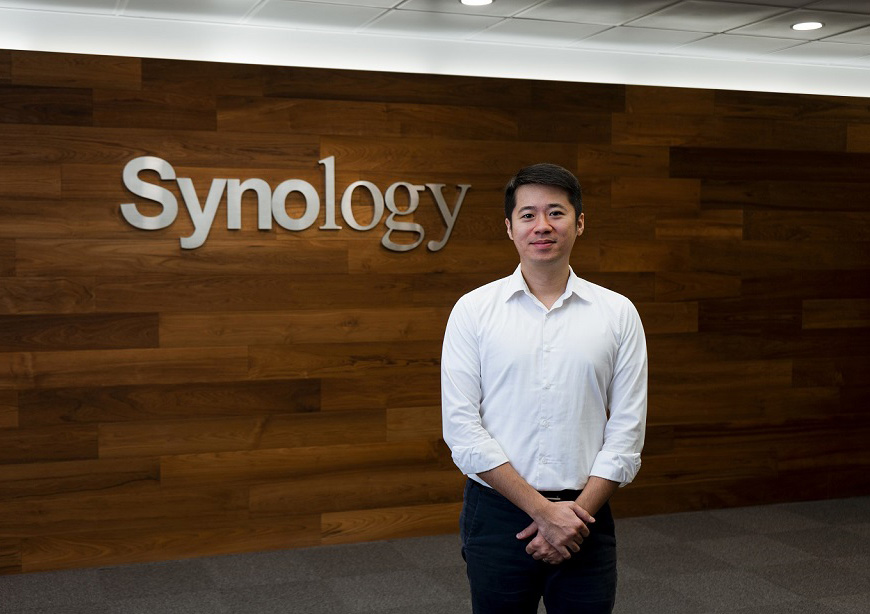
In cadrul Computex 2026, am avut ocazia sa stam de vorba cu domnul Chad Chiang – Managing Director Synology Germany & UK. Mai jos puteti vedea discutia noastra, concentrata atat pe noile produse prezentate la Computex, cat si pe directia companiei in viitor.
Q1: Hello and thank you so much for taking the time to answer our questions. First, please tell us more about yourself. How many years have you been with Synology? How does the company look now, compared to when you joined?
I have been with Synology for just over 16 years now. Looking back to when I first walked through the door, the transformation of the company has been incredible to witness.
When I joined a decade ago, Synology was primarily known—and fiercely loved—as a pioneer in the Network Attached Storage (NAS) space for tech enthusiasts, power users, and small businesses. We were the company that made data storage accessible, dependable, and frankly, fun to manage thanks to our DiskStation Manager (DSM) operating system.
Today, the company looks entirely different, yet beautifully familiar. While we still champion those core roots, Synology has evolved into a comprehensive enterprise data management powerhouse.
Here is how the landscape has shifted since I started:
From Storage to Ecosystem: We are no longer just about boxes that hold hard drives. We have built an expansive ecosystem that seamlessly bridges local hardware with our own secure cloud infrastructure (Synology C2).
Enterprise Scaling: A decade ago, a typical deployment might have been a few terabytes for a creative studio. Today, we are managing petabytes of data for massive global enterprises, providing highly sophisticated backup solutions, private cloud productivity suites, and enterprise-grade IP surveillance.
The Core Identity: What haven’t we changed? Our obsession with software excellence and data integrity. Even as we scale to support Fortune 500 companies, that user-centric, reliable DNA we had ten years ago is still exactly what drives us today.
It has been a thrilling decade of growth, and in many ways, it feels like we are just getting started as data challenges continue to evolve globally.
Q2: What do you think will be the most important new products and services Synology will show at this year’s Computex?
What stood out most at Computex this year, is how Synology is embedding AI across its entire ecosystem, not as a standalone technology, but as a practical capability designed to help users and organizations better manage, understand and protect their data.
The best place to start is with the next generation of DSM, which represents a major evolution for Synology. AI is becoming a native part of the user experience across both personal and professional workflows. On the consumer side, this can be seen within our BeeStation’s growing focus on intelligent photo and document management, helping users organize, search and retrieve information more naturally while maintaining control over their data.
For businesses, DSM’s new AI capabilities are increasingly focused on productivity and smart collaboration. In MailPlus, AI-powered summaries help users process their emails more efficiently, while Synology ChatPlus comes with intelligent prioritization features that make it easier to identify and focus on the most important conversations. Synology Meet further expands the collaboration suite with a private video conferencing platform that supports multi-language communication, helping teams work more efficiently in different languages. Taken together, these new features part of our next generation of DSM, brings AI directly into the workplace while preserving data ownership and privacy.
Beyond the AI-powered productivity solutions, one of the most significant announcement is ActiveProtect Manager 2.0. As cyber threats continue to evolve, organizations are looking for solutions that go beyond traditional backup and recovery. ActiveProtect Manager 2.0 advances Synology’s cyber-resilience strategy by adding new features such as AI driven threat detection capabilities that can identify suspicious activities, therefore, helping organizations detect potential attacks earlier and respond to them more efficiently. All this combined with an expanded workload protection, malware scanning and enhanced recovery capabilities, APM 2.0 reinforces our position in the growing cyber-resilience market.
Q3: Last year we saw the launch of the impressive Synology PAS7700, right here, at Computex. What was the reaction from the market? Did the number of orders you received from clients met (or exceeded) you expectations?
The market reaction to the PAS7700 has been absolutely phenomenal and honestly exceeded our internal forecasts. When we debuted this all-NVMe active-active flagship, our goal was to prove Synology could seamlessly handle Tier-1, mission-critical enterprise workloads—and the response from IT architects proved the demand was massive. Order volumes outperformed expectations primarily because the PAS7700 launched right alongside the explosion of on-premises AI training and high-performance virtualization, where its sub-millisecond latency and massive IOPS were exactly what enterprises needed. What ultimately drove those numbers past our targets, though, was our software; clients were thrilled to get true enterprise-grade power combined with the signature simplicity of our DSM interface, making it an easy choice over complex, legacy SAN systems.
Q4: I can’t help but notice that in the last few years Synology has focused more and more on business solutions (cloud, surveillance), and it feels like the consumer part of the business (SOHO NAS and routers) is getting a little bit less attention. Is this still an important market for Synology?
That is a fair observation, and I get why it might look that way from the outside given how loudly we talk about our enterprise growth. However, I want to be absolutely clear: the consumer and SOHO market is not just important to Synology—it is our foundation, and we are not walking away from it.
The reality is that the lines between “consumer” and “business” technologies have completely blurred. Today, a prosumer, content creator, or remote worker needs data protection, ransomware defense, and hybrid cloud integration that matches what Fortune 500 companies use. Because of this, our development strategy has shifted; instead of building isolated features for home users, we are trickling our most powerful enterprise-grade security and backup technologies directly down into our SOHO systems.
Our home users and tech enthusiasts are the heart of Synology—they are the ones who challenge us, advocate for us, and keep our community thriving. While our marketing might spotlight multi-petabyte systems, our engineering teams are just as focused on refining the compact, reliable DiskStations and networking gear that power millions of homes and small offices worldwide.
Q5: I am an enthusiast Synology NAS user (DS1621xs+), and I also use the Synology hard drives (HAT3310 Plus), for an extra layer of security and data safety. However, I do appreciate the flexibility to choose any HDD or SSD vendor. Synology actually went through a bit of a carousel regarding this topic last year. What was the main reason for the HDD and SSD lock, and why did the company revert it’s decision?
First, thank you for using our Plus-series drives in your DS1621xs+; that combination offers fantastic peace of mind.
To address the “carousel” you mentioned: our initial decision was driven entirely by an engineering desire for absolute reliability. As enterprise workloads—like on-premises AI training and massive virtualization pools—started trickling down to high-end desktop units, we wanted to guarantee zero-downtime performance. By pairing our custom DiskStation Manager (DSM) with tightly controlled drive hardware, we could eliminate unexpected firmware conflicts, optimize drive health monitoring, and streamline technical support.
However, we quickly realized the values the fundamental DNA of the Plus series: flexibility and freedom of choice. The feedback from our most loyal power users, enthusiasts, and small business owners was loud, clear, and immediate. They felt locked in, and some even hesitated to upgrade their hardware.
We listen to our community. That is why with the rollout of DSM 7.3, we officially lifted that restriction for our 2025 DiskStation Plus models. You can once again build your storage pools using trusted third-party 3.5-inch HDDs and 2.5-inch SATA SSDs from vendors like Western Digital or Seagate without losing core functionality. We still highly recommend validated drives for mission-critical setups, but we are back to giving the choice and control entirely to the user.
Q6: Synology has long integrated AI into it’s surveillance solutions, and this year you are preparing to announce AI integration for products targeted at home users. Can you give us more details about the benefits consumers should expect from such a solution?
Our biggest focus with this consumer-facing expansion is delivering meaningful intelligence while maintaining strict data privacy and sovereignty—meaning all your AI processing stays 100% local, private, and under your control, without sending your life’s data to an external cloud.
At Computex, we highlighted how these features are rolling out across our ecosystem, and consumers will see the immediate benefits in two major areas:
Smarter, Faster Data Discovery: We are completely rewriting how you interact with your files through a new local feature called Synology Deep Search. Instead of hunting through endless folder structures, you can use conversational, natural language to find personal files, documents, and photos across your NAS instantly—with the AI handling the heavy lifting completely on-premises.
Intelligent, Private Smart Homes: We are bringing enterprise-grade, edge-AI security to everyday households. Through our updated BeeSeries ecosystem and the introduction of BeeCamera, users can turn a standard home-monitoring setup into an intelligent, private security hub. Combined with the local image analysis and smart object/facial recognition tools built into Synology Photos, home users are getting the exact same kind of efficient, automated metadata tagging and threat detection that enterprise IT administrators use, packaged for a frictionless, consumer-friendly experience.
Ultimately, we are proving that you don’t have to sacrifice your personal privacy to get the cutting-edge benefits of modern AI.
Q7: Artificial intelligence is certainly a big step forward for humanity, with an undeniable positive impact on society. However, there are also some unintended consequences, from deep fakes and scams using AI, to the way in which it can affect children’s learning and development in schools. In the long term, do you think we as a society will be able to benefit from the positive impact that AI can have, while also keeping the potential negative effects under control? Especially in the case of a technology that is evolving exponentially from year to year?
That is the defining question of our generation, and it is something we discuss constantly at the leadership level. When you look at a technology moving at an exponential rate, it is easy to feel a sense of vertigo. But looking at it through the lens of history and our tech evolution at Synology, I am a pragmatic optimist. I believe we will absolutely harness the net positives, but it is going to require a fundamental shift from reactive regulation to proactive design.
Historically, humanity has a strong track record of building guardrails for its most disruptive innovations—think of aviation safety, automobile regulations, or data privacy laws like GDPR. The difference here, as you rightly pointed out, is the sheer speed of AI’s evolution. Traditional legislative bodies move linearly, while AI moves exponentially. To bridge that gap, the solution cannot just come from governments; it has to be baked into the technology itself by the creators.
Ultimately, keeping AI under control isn’t about slowing down progress—it’s about speeding up our adaptability. It requires a collaborative effort between tech developers, educators, and policymakers. If we commit to building “secure by design” frameworks and prioritizing data sovereignty and privacy, society will look back on this AI transition not as a loss of control, but as the moment we unlocked entirely new levels of human potential.
Q8: What is your opinion on the DRAM crisis and how do you expect it will affect your business in 2026? Do you think the impact on the industry will be long lasting – will it extend beyond 2026?
The 2026 DRAM crisis is a profound structural shift, not just a temporary spike, driven entirely by chipmakers pivoting their production capacity toward high-bandwidth memory (HBM) to feed the insatiable AI data center market. For Synology, this has created a severe deficit in standard DDR4 and DDR5 memory, forcing us to absorb significant cost volatility on high-end enterprise systems like our PAS7700 while heavily optimizing our DSM software to keep consumer DiskStations lightweight and affordable despite surging RAM prices. Because building new fabrication facilities takes years, we expect these supply constraints and elevated prices to baseline well beyond 2026, meaning we are completely re-engineering our procurement cycles to secure allocations up to 30 weeks in advance for the foreseeable future.
Q9: Which Synology product / service are you most excited about and why?
Without a doubt, it has to be the Synology PAS7700 that we debuted in May this year.
Having been with the company for over a decade, I’ve seen us master file storage and backup for millions of users, but the PAS7700 represents a monumental leap into a completely different tier of computing. It is our first true all-NVMe, active-active dual-controller flagship designed from the ground up for mission-critical enterprise environments.
What gets me incredibly excited about it isn’t just the jaw-dropping hardware specs—like pushing up to millions of IOPS with sub-millisecond latency—but the massive software evolution behind it. We have successfully injected our signature DSM simplicity into a high-end system that can seamlessly power Tier-1 virtualization and on-premises AI infrastructure. For years, enterprises had to tolerate incredibly complex, rigid legacy SAN setups to get this level of performance and uptime. Seeing our engineering teams shatter that status quo and deliver a high-availability powerhouse that an IT administrator can deploy in minutes is easily the most thrilling milestone of my career here.
Thank you very much for your time! We look forward to seeing exciting new developments from Synology in the future.




Comentarii